

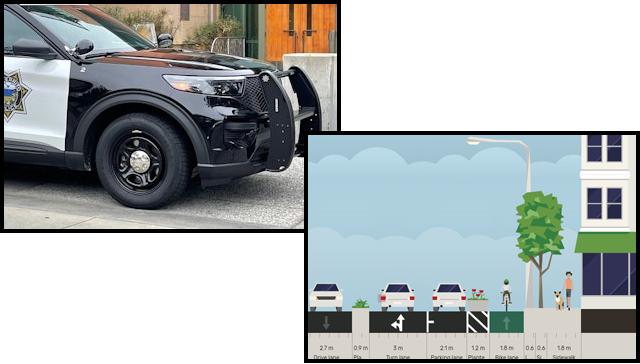
Police officers are not trained to evaluate how street design impacts residents’ safety.
By Steve Price
Whenever a car crash kills or injures a pedestrian or bicyclist, people will say that the police department needs to do more traffic enforcement. But rarely are the designs of the street or intersection or vehicle examined. It is very difficult for a police officer to identify design errors in a crash report. That’s not what police are trained in. We can’t expect an officer to do an in-depth examination of the street, intersection, or vehicle designs. They are not a traffic engineers, civil engineers, or otherwise familiar with how dummies fare at the National Highway Traffic Safety Administration crash tests.
If the police don’t get blamed for being lax, then the pedestrian or motorist gets the blame—it was human error. The pedestrian shouldn’t have crossed the street at that location, or they shouldn’t have been wearing dark clothing, or a parent shouldn’t have let a child bicycle on that street, or the motorist shouldn’t have been looking at the touch screen on the dashboard.
Past generations that assumed that streets are primarily for the speedy movement of ever- increasing sizes of cars have left America with a built landscape filled with dangers. Policing, or Day-Glo clothing, or indestructible vehicles are not panaceas. Our biggest safety challenge is moving beyond the street designs of the past and designing our streets and vehicles for the safety of all.
This is all very well explained in a book entitled Killed by a Traffic Engineer by Wes Marshall, a professor of civil engineering and urban planning at the University of Colorado, Denver. Marshall writes that traffic engineering’s focus on speed and road capacity has made America’s streets unsafe (think San Pablo Avenue).